
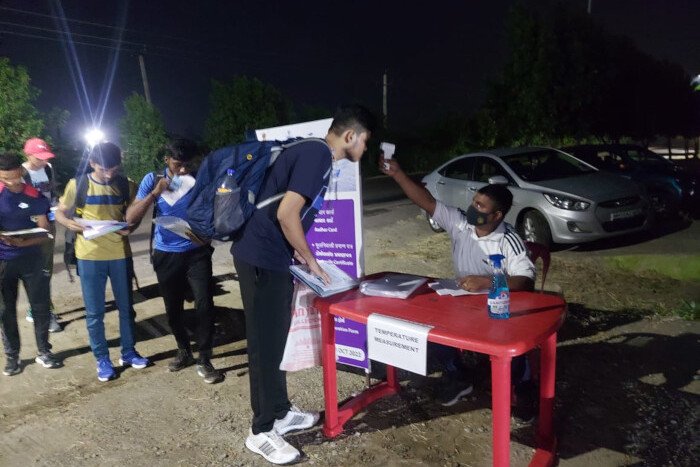
File photo: an Agnipath scheme recruitment drive at INS Valsura, Jamnagar. Indian Navy (GODL-India). Wikimedia Commons. Source URL. Published under GODL-India. Cropped and resized.
Defence Minister Rajnath Singh used a Deepavali-eve visit to the Bagdogra Air Force station on Saturday to deliver a policy message: every Agniveer who completes the newly announced two-year extension will be eligible for enrollment as a regular soldier, subject to willingness and selection criteria, PTI reported.
The scheme as launched
The Agnipath scheme, started in June 2022, recruits soldiers for a four-year term, with a provision to retain only 25% of each batch in regular service. The first batches recruited under it are now approaching the end of those four years.
What the government announced
Days before Mr. Singh spoke, Chief of Defence Staff General N.S. Raja Subramani announced that Agniveers set to exit the military at the end of their four-year tenure will be given an additional two-year extension, with subsequent permanent recruitment subject to meeting specific eligibility criteria, PTI reported. “Upon completion of the two-year engagement period, all Agniveers will get an opportunity to be enrolled as regular soldiers,” Mr. Singh said, subject to their willingness and their meeting the selection criteria.
Why it matters
For the earliest Agniveer cohorts, the extension means another two years in uniform and a second chance at a regular rank beyond the original 25% retention rule. Mr. Singh called the decision a “significant Diwali gift for Agniveers” and reiterated the government’s commitment to the welfare of defence personnel and their families.
The backdrop
Mr. Singh visited armed forces at multiple West Bengal locations on Saturday. At Bagdogra, near the frontier with China in the eastern sector, he called for the highest level of operational readiness and described the northeast as India’s “first edge”, The Hindu reported. He later reviewed the Army’s Trishakti Corps at Sukna, with a focus on infrastructure along the LAC.