
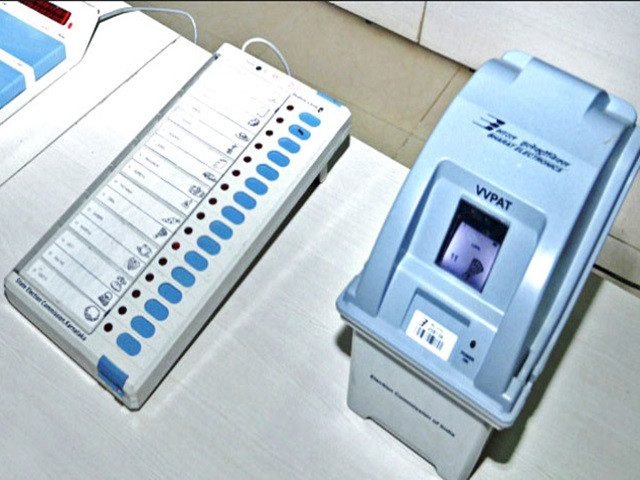
File photo: an electronic voting machine and VVPAT unit. Election Commission of India. Wikimedia Commons. Source URL. GODL-India. Resized.
The INDIA bloc is campaigning for Chief Election Commissioner Gyanesh Kumar’s resignation over alleged ‘vote chori’ and held what it calls a “public impeachment” programme, postponed by rain to Saturday. But what does the Constitution actually provide for removing a CEC? The answer is in Article 324(5).
What Article 324(5) says
The proviso to Article 324(5) of the Constitution states: “the Chief Election Commissioner shall not be removed from his office except in like manner and on the like grounds as a Judge of the Supreme Court and the conditions of service of the Chief Election Commissioner shall not be varied to his disadvantage after his appointment.” A further proviso says any other Election Commissioner or a Regional Commissioner “shall not be removed from office except on the recommendation of the Chief Election Commissioner.”
The judge-removal route it borrows
Removal “in like manner and on the like grounds as a Judge of the Supreme Court” points to Article 124(4): “A Judge of the Supreme Court shall not be removed from his office except by an order of the President passed after an address by each House of Parliament supported by a majority of the total membership of that House and by a majority of not less than two-thirds of the members of that House present and voting has been presented to the President in the same session for such removal on the ground of proved misbehaviour or incapacity.” In other words, removing a CEC requires the same special majority in both Houses of Parliament, on those grounds.
What a ‘public impeachment’ is
The INDIA bloc’s programme is a political campaign event, not a constitutional mechanism. The bloc said its “public impeachment” would avoid imagery that could be seen as mocking Parliament as an institution, according to The Hindu’s morning digest. A Chalo Dilli march from Connaught Place to Ramlila Maidan is planned for November 1.
How a CEC is appointed
Article 324(2) says the Chief Election Commissioner and other Election Commissioners are appointed by the President, subject to the provisions of any law made by Parliament. Article 324(1) vests the superintendence, direction and control of elections in the Election Commission of India.
That law now is the Chief Election Commissioner and Other Election Commissioners (Appointment, Conditions of Service and Term of Office) Act, 2023 (No. 49 of 2023). Under section 7, the President appoints the CEC and other Election Commissioners on the recommendation of a Selection Committee of the Prime Minister (chairperson), the Leader of Opposition in the Lok Sabha and a Union Cabinet Minister nominated by the Prime Minister. Petitions before the Supreme Court challenge the Act, including for removing the Chief Justice of India from the selection body prescribed under the Constitution Bench’s 2023 Anoop Baranwal arrangement. On September 23, 2026, a two-judge bench delivered a split opinion and placed the petitions before the Chief Justice of India to constitute a larger bench. The Act remains in force, and appointments continue to be made under it.
Sources: Constitution of India · The Hindu · The Hindu digest · CEC & EC Appointment Act, 2023 (eGazette PDF) · SC judgment, Sep 23, 2026 (PDF) · Appointments under the Act (eGazette PDF)