
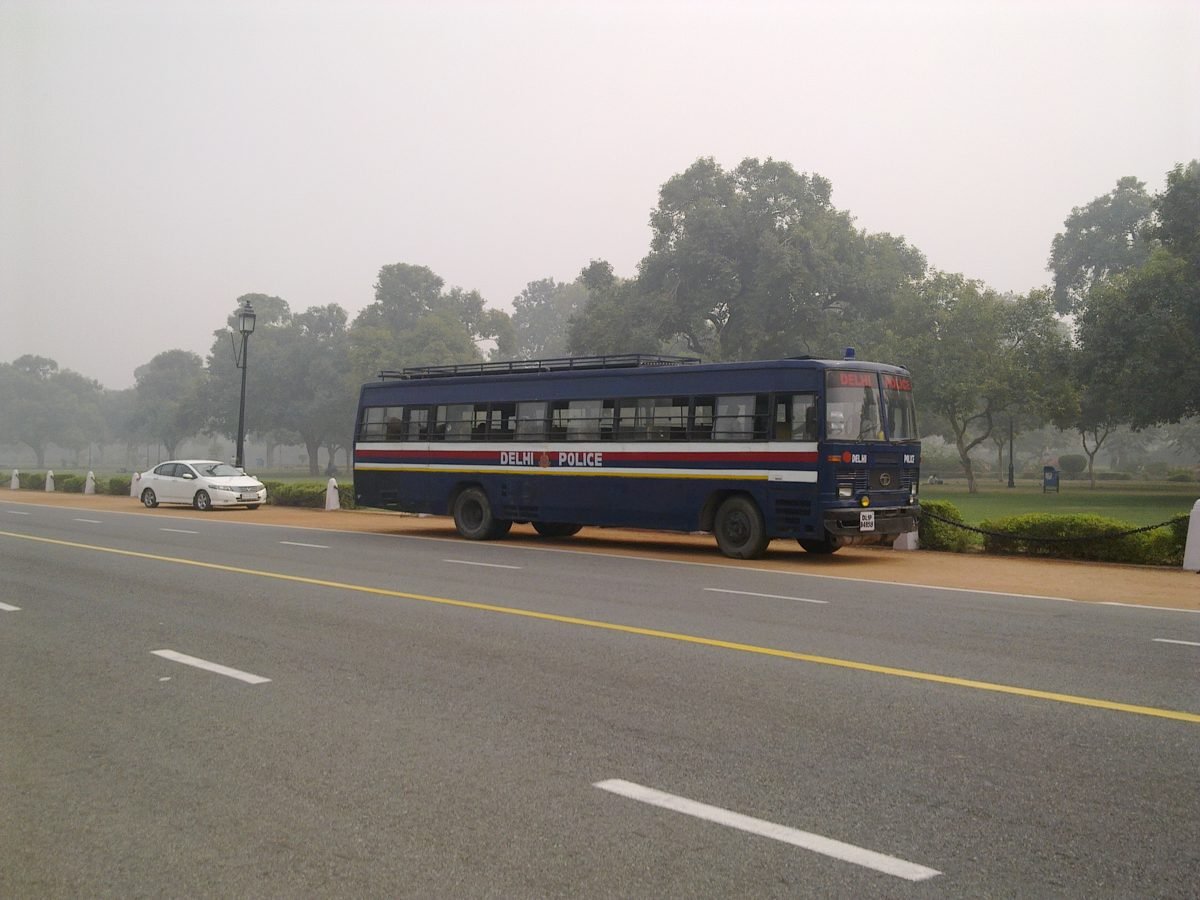
Representative file photo: a Delhi Police bus in New Delhi, November 2015. juggadery. Wikimedia Commons. Source URL. CC BY-SA 2.0. Resized.
Delhi Police detained two NSUI members outside Jamia Millia Islamia on Wednesday, where public assembly has been banned under Section 163 of the Bharatiya Nagarik Suraksha Sanhita (BNSS), The Hindu reported. Here is what that provision says, based on the text of the section published in the Gazette of India.
What Section 163 allows
Section 163, titled “Power to issue order in urgent cases of nuisance or apprehended danger”, lets a District Magistrate, Sub-divisional Magistrate or a specially empowered Executive Magistrate direct any person “to abstain from a certain act” when the Magistrate considers it likely to prevent “obstruction, annoyance or injury to any person lawfully employed, or danger to human life, health or safety or a disturbance of the public tranquillity, or a riot, or an affray”. The order must be written and state the material facts of the case.
Who it can bind, and for how long
An order may be directed to a particular individual, to persons in a particular place or area, or to the public generally when frequenting that place, and in emergencies it can be passed ex parte, without prior notice. No order can remain in force for more than two months, though the state government may extend it by notification up to six months from the date it would otherwise have expired, for preventing danger to life, health or safety, or a riot or affray.
Changing or cancelling an order
Any Magistrate may rescind or alter their own order or one made by a subordinate or predecessor, either on their own motion or on the application of a person aggrieved; the state government holds the same power over its own extension orders.
The Jamia context
The ban at Jamia comes amid a hunger strike that entered its 17th day on Wednesday, demanding restoration of the university’s students’ union, dissolved in 2006. The university has alleged overnight vandalism by protesters, which the protesters deny. Five students remain on hunger strike.