
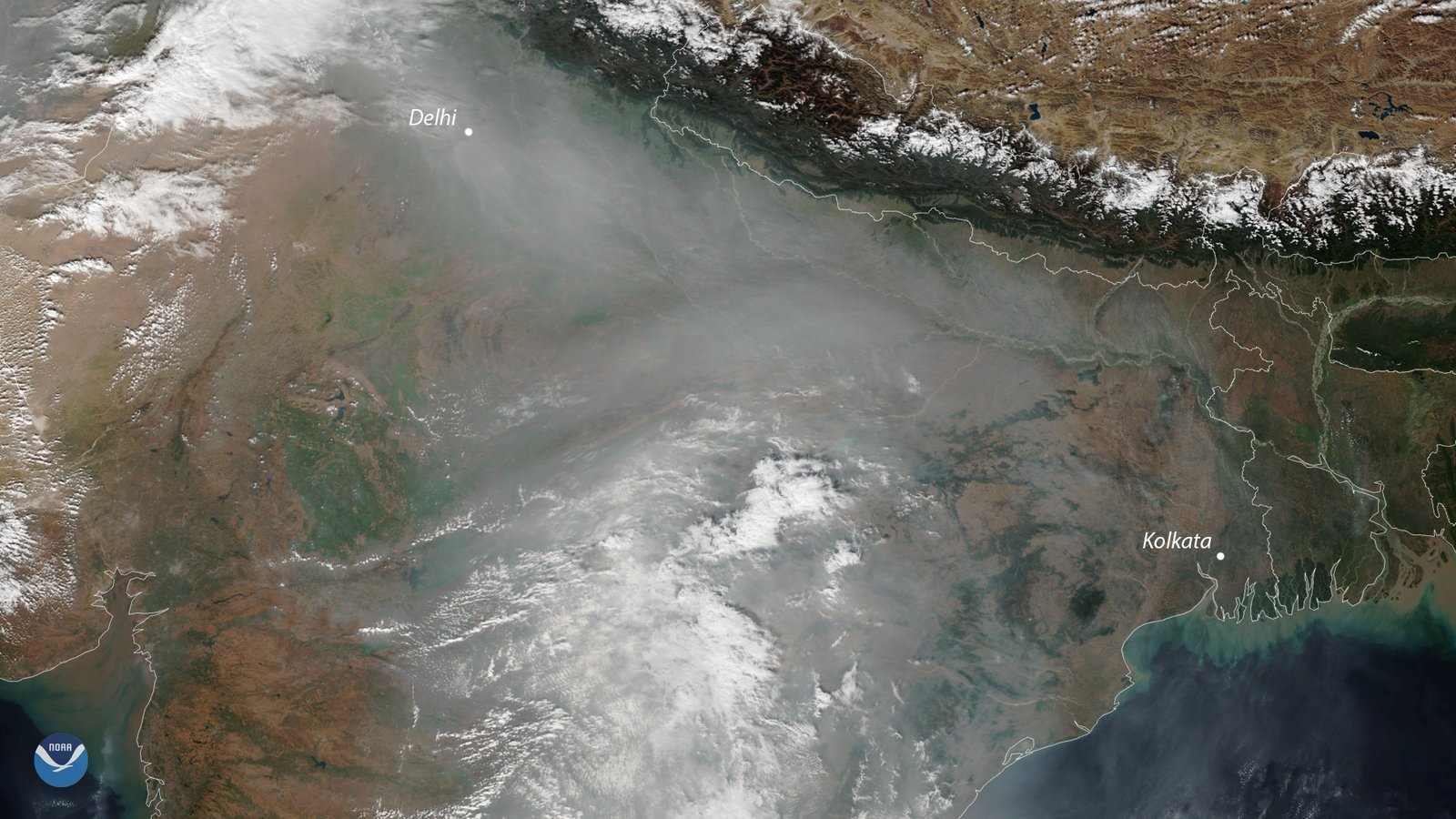
Satellite image: thick smog over northern India, November 2019, from NOAA. Thick Smog Blankets India’s Capital City (NESDIS 2019-11-01 delhi-image).jpg. Wikimedia Commons. Source URL. Public domain. Cropped and resized.
Delhi-NCR is under Stage 2 of the Graded Response Action Plan (GRAP) after the city’s AQI hit 324 on Monday, and the air has stayed very poor since – 369 at 6:05 am on Wednesday, India Today reported. GRAP is the region’s emergency playbook for exactly this situation.
What GRAP is
GRAP is a set of emergency measures invoked by the Commission for Air Quality Management (CAQM) to stop air quality from deteriorating further once it crosses fixed thresholds. Each stage adds restrictions on top of the previous one.
The four triggers
Under the CAQM’s GRAP schedule, GRAP-1 kicks in when the AQI is between 201 and 300 (poor); GRAP-2 between 301 and 400 (very poor); GRAP-3 between 401 and 450 (severe); and GRAP-4 when the AQI crosses 450 (severe plus). Stages can be invoked in advance, on IMD and IITM forecasts, before the AQI actually reaches the projected level. Delhi’s AQI went from 117 on October 31 to 261 on November 1 and 324 on November 2, which is what brought Stage 2 into force.
What Stage 2 changes on the ground
Stage 2 targets dust and traffic. Authorities intensify mechanical road cleaning, water sprinkling and the use of anti-smog guns, NCR state governments are mandated to enhance parking fees so that private vehicles stay off the road, and public offices in Delhi and the adjoining NCR districts stagger timings. Stage 2 itself does not bar any vehicle category: the curbs on vehicles come from the seasonal and standing orders described below. Vehicle restrictions enter the GRAP schedule only at Stage 3, when BS-III petrol and BS-IV diesel or older light motor vehicles can be restricted in Delhi and high-density NCR districts.
A separate ban already running
Separately from GRAP, a Delhi government order bars vehicles registered outside Delhi that do not meet BS-VI emission norms from entering the capital between November 1, 2026 and January 31, 2027, with CNG, electric, emergency and government-duty vehicles exempt (Hindustan Times, Indian Express). It is a season-long winter measure, not a GRAP stage, and because it applies to outside-registered vehicles it does not change the position for Delhi-registered cars, which remain allowed with a valid PUC. Under a standing CAQM direction, commercial goods vehicles registered outside Delhi that are BS-III or older have been barred from entering the capital since November 2025, and the entry window for outside-registered BS-IV goods vehicles closed on October 31, 2026 – so only BS-VI, CNG, LNG or electric goods vehicles can now enter (CAQM order).
What would ease the clamp is the reverse of what triggered it: sustained improvement in the AQI. Wednesday’s forecast offered no such relief, with a clear sky, no rain and temperatures between 14 and 29 degrees Celsius.